
The shift towards diversifying textile supply chains beyond China is already well underway and has gained momentum following the successive changes in US trade policy introduced since 2025. While the US tariff framework affecting the textile sector now appears to be entering a more stable phase, competitive dynamics among apparel-producing nations continue to evolve. Building on its 2025 study identifying the most attractive alternatives to China for textile manufacturing, Coface has updated its ranking to incorporate the latest changes to US import duties.
Recent changes to the US tariff regime are reshaping the hierarchy of the most competitive countries in the apparel and footwear industries.
They are likely to reinforce the position of several suppliers across Asia and Africa, while further highlighting that supply chain diversification away from China is a long-term structural trend.
states Eve Barre, sector economist at Coface.
China’s Dominance faces growing challenges
China remains the world’s largest exporter of apparel and footwear. However, its share of global exports has been gradually declining. Rising labour costs and the increasing determination of multinational companies to diversify sourcing strategies have both contributed to this trend.
To assess which countries are best positioned in this changing environment, Coface has refreshed its competitiveness index for the apparel and footwear sector. The ranking is based on four key dimensions:
- Quality of the business environment;
- Availability of cost-competitive labour;
- Social and environmental performance;
- Strength of the domestic textile manufacturing ecosystem.
The updated analysis now also includes a factor linked to US tariffs. Recent tariff adjustments have altered the relative attractiveness of many manufacturing locations. Although some duties have been reduced or removed, Chinese exports continue to face higher tariff barriers than those of several competing countries. Over time, this could significantly reshape the global distribution of textile production.
Lesotho and Madagascar Emerging as potential major winners
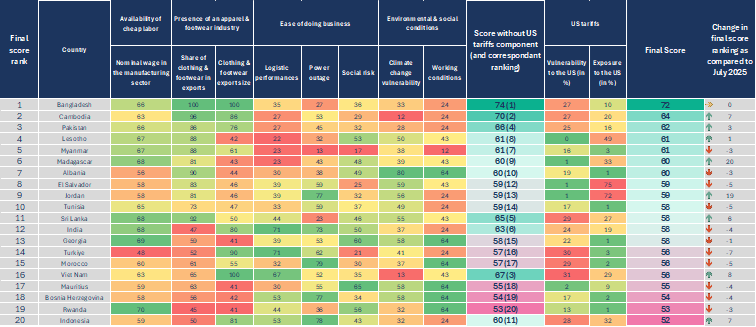
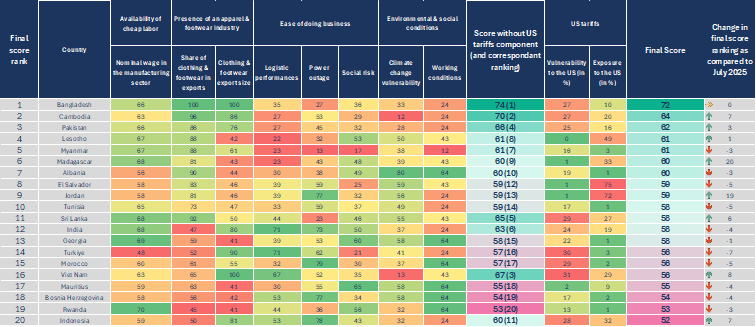
Bangladesh continues to hold the leading position in Coface’s competitiveness ranking. The most notable change, however, is the strong rise of Lesotho and Madagascar, both of which now rank among the sector’s most competitive locations after being absent from the summer 2025 edition.
Their improved performance is largely attributable to the removal of additional duties that previously restricted access to the US market. Several Asian manufacturing hubs have also strengthened their standing, including Cambodia, Pakistan and Sri Lanka. Meanwhile, Vietnam and Indonesia have entered the Top 20, reflecting their growing importance within global apparel supply chains and their ability to benefit from shifting trade patterns.
A new global map of textile production
The latest ranking highlights a broader structural shift: competitiveness in the textile and apparel industry is no longer determined solely by labour costs. Market access, trade policies, industrial capabilities and macroeconomic stability are now equally important factors in sourcing decisions.
As companies seek to build more resilient supply chains amid persistent trade tensions, countries capable of combining competitive production costs, strong manufacturing expertise and favourable access to major consumer markets are attracting greater attention from international investors and buyers. The recent evolution of US tariff policies also demonstrates how quickly regulatory changes can alter the competitive landscape and influence the distribution of production across manufacturing countries.
Competitiveness score for the apparel and footwear industry (z-score)
Data used for the graph in .xlsx format
> What has changed in just over a year? Revisit our 2025 analysis to see how shifts in US trade policy have reshaped the relative competitiveness of apparel-producing countries.
> Explore our updated textiles and clothing sector risk assessment.


